
EVERYDAY SCIENCE · SKY
Why does the Moon change shape?
The Moon does not change at all. The Sun always lights one half of it, and as the Moon circles the Earth about once a month we see that lit half from a changing angle: none of it at new Moon, a sliver a few days later, all of it at full Moon. Earth’s shadow has nothing to do with it.
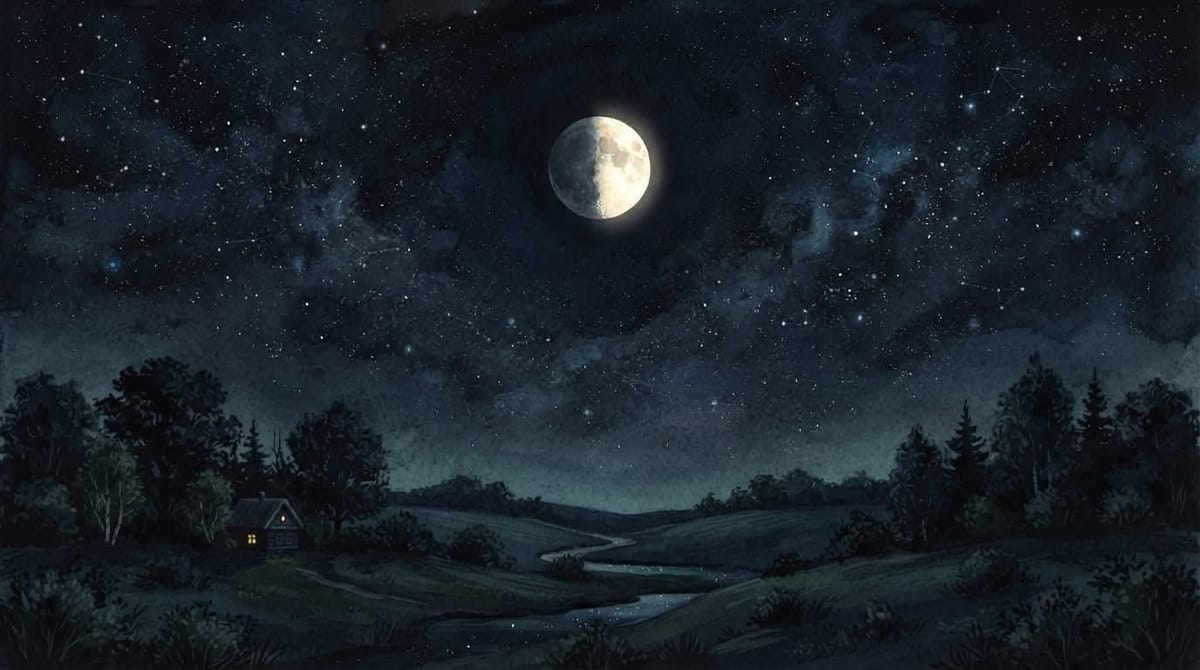
- The Sun lights half the Moon
- The Moon circles the Earth
- Our view of the lit half changes
Always half lit
Like any ball in sunlight, the Moon is bright on the side facing the Sun and dark on the other. That is true every day of the month. Seen from far above, the Moon would always look half lit, wherever it was on its path round the Earth.
What changes is our view. From Earth we look at that half-lit ball from a different direction each night, and how much of the bright half is turned towards us is the phase.
Read the source: NASA Science: Moon phases
Why it is not Earth’s shadow
Many people think the dark part of a crescent Moon is the shadow of the Earth. It is a natural guess, and it is wrong. Earth’s shadow points straight away from the Sun, and the Moon’s orbit is tilted, so in most months the shadow misses the Moon altogether.
When the shadow does fall on the Moon we get something different and much rarer: a lunar eclipse. A crescent comes round every month, and the dark part of it is simply the Moon’s own night side.
Read the source: OpenStax Astronomy 2e: Phases and motions of the Moon
Round the month
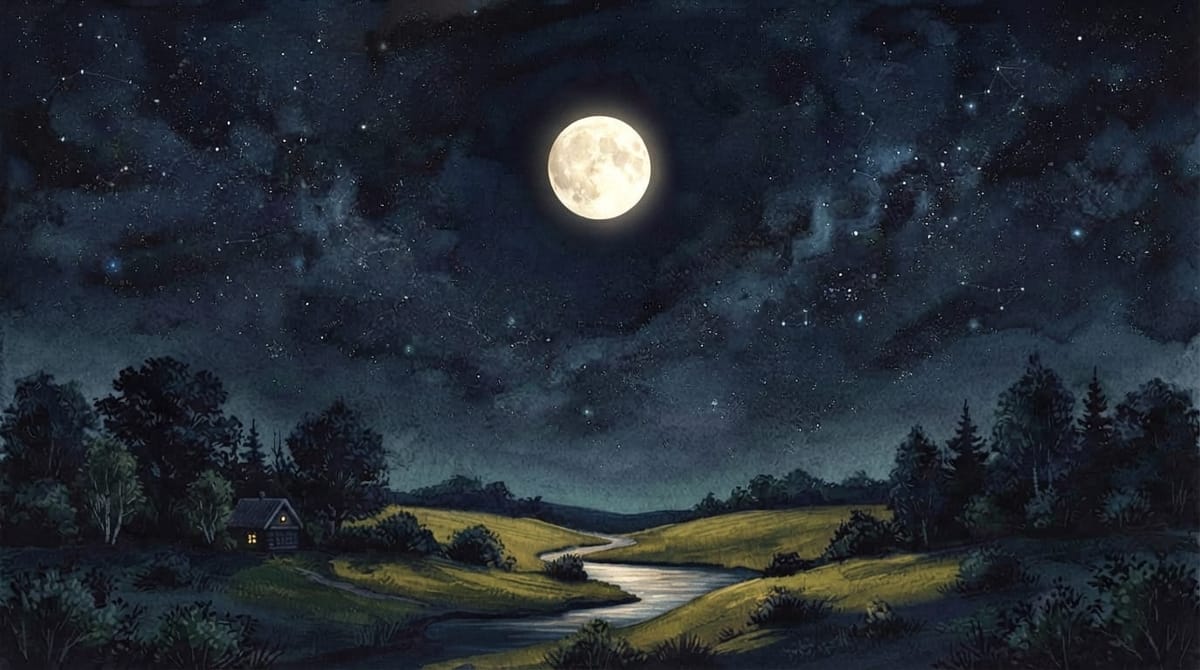
At new Moon the Moon is in the same part of the sky as the Sun. Its lit half faces away from us, and it is up during the day, so we do not see it. A few days later we catch the edge of the lit half as a thin crescent, which grows daily as the Moon’s orbit carries its day side into view.
After about a week the Moon is a quarter of the way round and we see half of its lit side. This is called first quarter, named for the distance travelled and not for the shape. After about two weeks the Moon is opposite the Sun, the whole lit half faces us, and it is full. Then the same phases run in reverse, back to new Moon about 29.5 days after the last one.
Read the source: NASA Science: Moon phases
Try it with a lamp and a ball
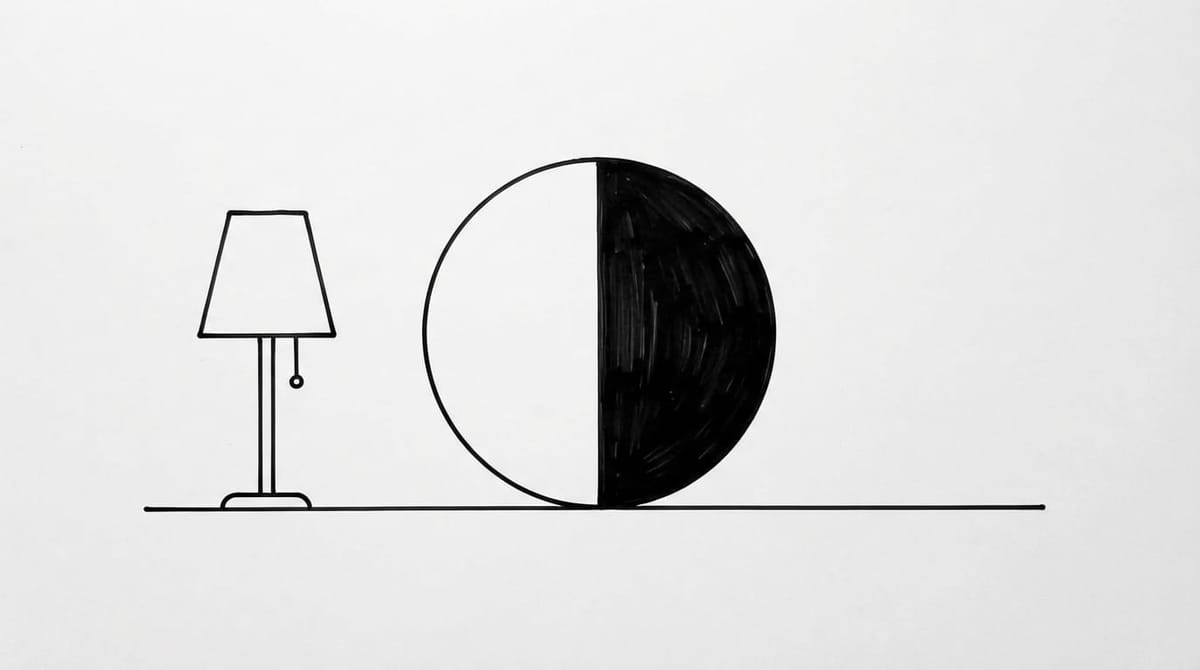
You can make every phase in a dark room. Stand about two metres from a bright lamp and hold a ball out at arm’s length. The lamp is the Sun, your head is the Earth and the ball is the Moon. Turn slowly on the spot, carrying the ball round you, and watch it: a thin crescent, a half, a full disc when the lamp is behind you, and back again.
Keep the ball clear of the shadow of your head as it passes behind you. If the shadow does fall on it, you have made a lunar eclipse, which shows why eclipses need a special line-up and phases do not.
Read the source: OpenStax Astronomy 2e: Phases and motions of the Moon
A question worth taking into the lesson
“If the Moon is always half lit, why do we ever see less than half?” is the question to bring. Ask Clevaa to draw the Sun, the Earth and the Moon from above, then to show what a person on Earth sees at each position.
Then explain it back: the Sun lights half the Moon, the Moon goes round the Earth in about a month, and the phase is how much of the lit half faces us.
A few useful answers
How long does the cycle of phases take?
About 29.5 days from one new Moon to the next. The Moon needs only about 27.3 days to circle the Earth, but the Earth has moved on round the Sun in the meantime, so the Moon has to travel a little farther to come back to the same phase.
Why is there not an eclipse every month?
Because the Moon’s orbit is tilted, so in most months Earth’s shadow misses the Moon.
Why do we always see the same face of the Moon?
The Moon turns once on its axis in exactly the time it takes to go once round the Earth, so the same side always faces us.
TAKE THE NEXT QUESTION WITH YOU
Turn the explanation into a conversation.
Open this topic in Clevaa, choose a level, and ask the part you want to explore.
Hear the phases explained with pictures ↗You choose when to start. Session availability and usage limits may apply.
Keep exploring
 EVERYDAY SCIENCE · OCEANS
Why does the sea have tides?
The Moon pulls the near side of Earth harder than the far side, so the ocean stretches into two bulges and the spinning Earth carries every coast through them. Why there are two high tides a day, and what the Sun adds.
Explore EVERYDAY SCIENCE · TIME
Why do we have leap years?
Earth needs about 365 and a quarter days to go round the Sun, so a 365-day calendar falls a day behind every four years. Why 29 February exists, why 1900 skipped it and 2000 did not, and when the next one comes.
Explore LEARNING YOU CAN LOOK ATSee the idea you are trying to understand.
See ideas take shape with Clevaa, a visual AI tutor. Learn through spoken explanations, illustrations and diagrams, then ask about the part you want to understand.
Explore