
EVERYDAY SCIENCE · KITCHEN
Why do onions make you cry?
A whole onion is harmless. Cutting it breaks open its cells, and chemicals that were kept apart meet and make a gas that floats up and stings your eyes. The tears are your eyes rinsing it away.
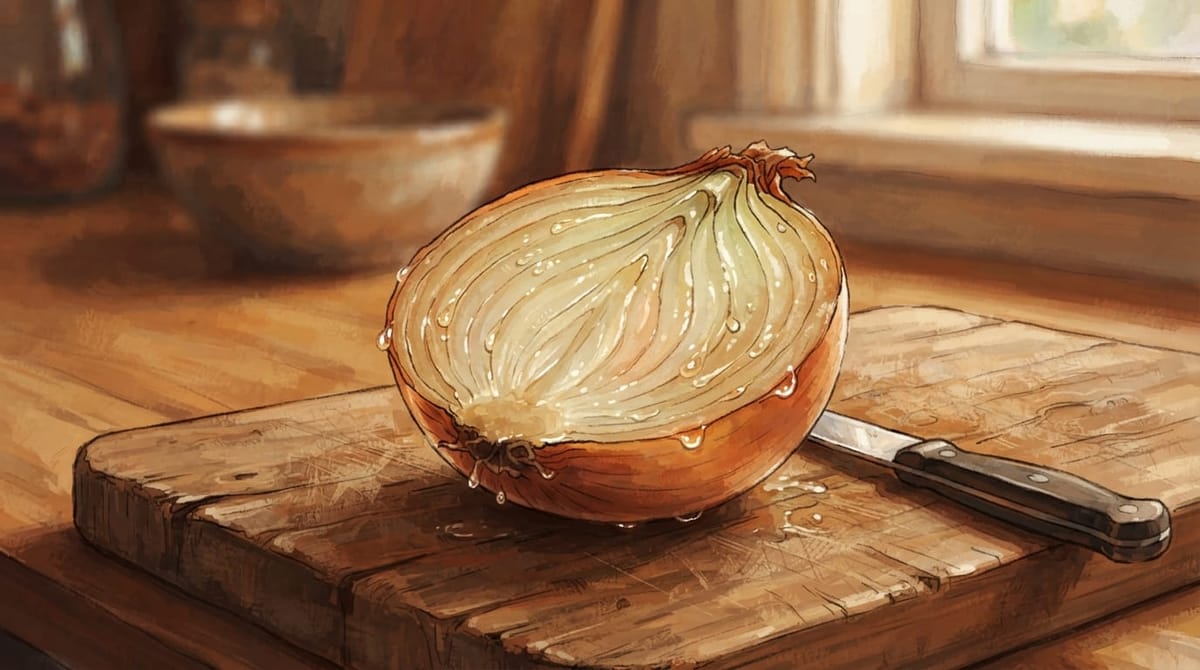
- The knife breaks the cells
- Enzymes make a stinging gas
- Tears rinse the eye
Nothing happens until you cut
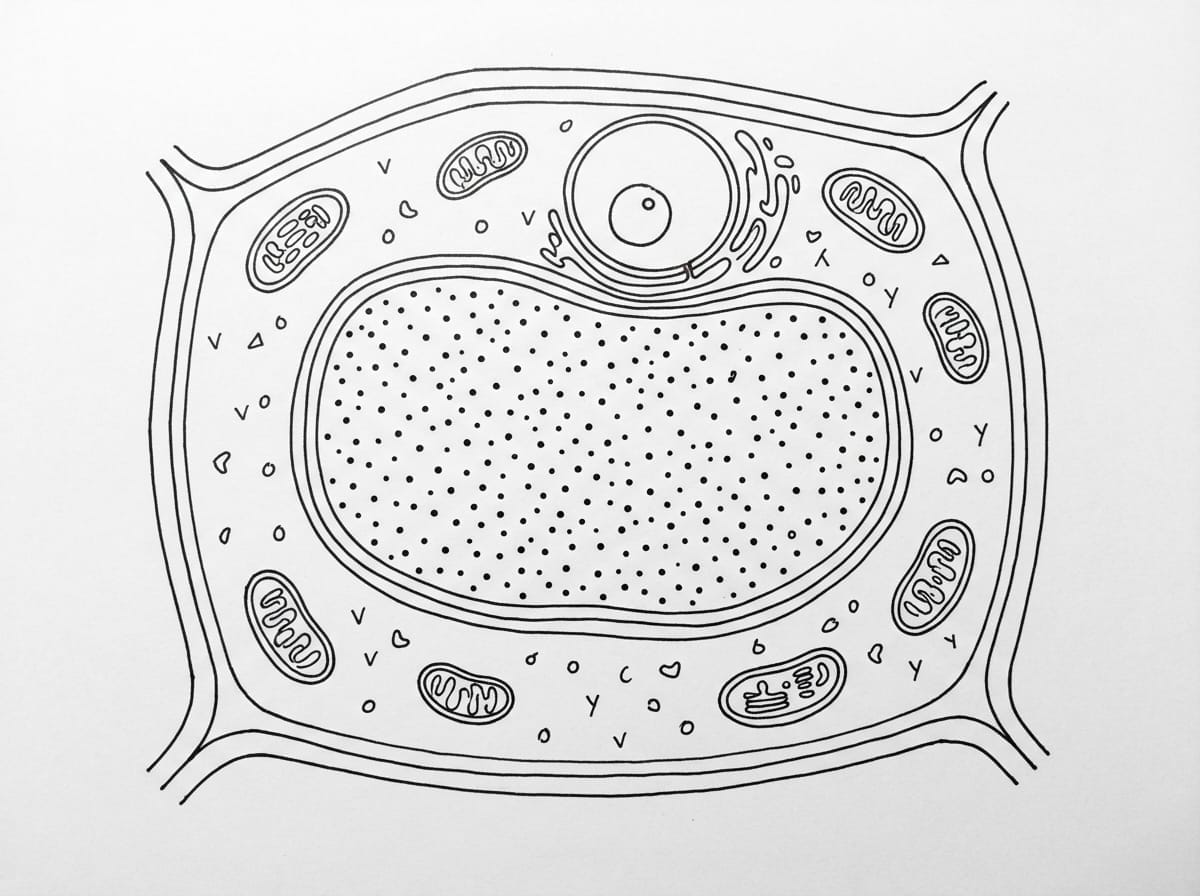
An onion is good at taking up sulfur from the soil, and it builds that sulfur into amino acids. Inside its cells these sulfur compounds are kept apart from the enzymes that can act on them, so nothing happens while the onion is whole.
A common mix-up is to picture the stinging chemical sitting in the onion, waiting. It does not exist yet. It is made on the chopping board in the moments after the blade goes through.
Read the source: Encyclopaedia Britannica: Why do onions make you cry?
What the blade sets off
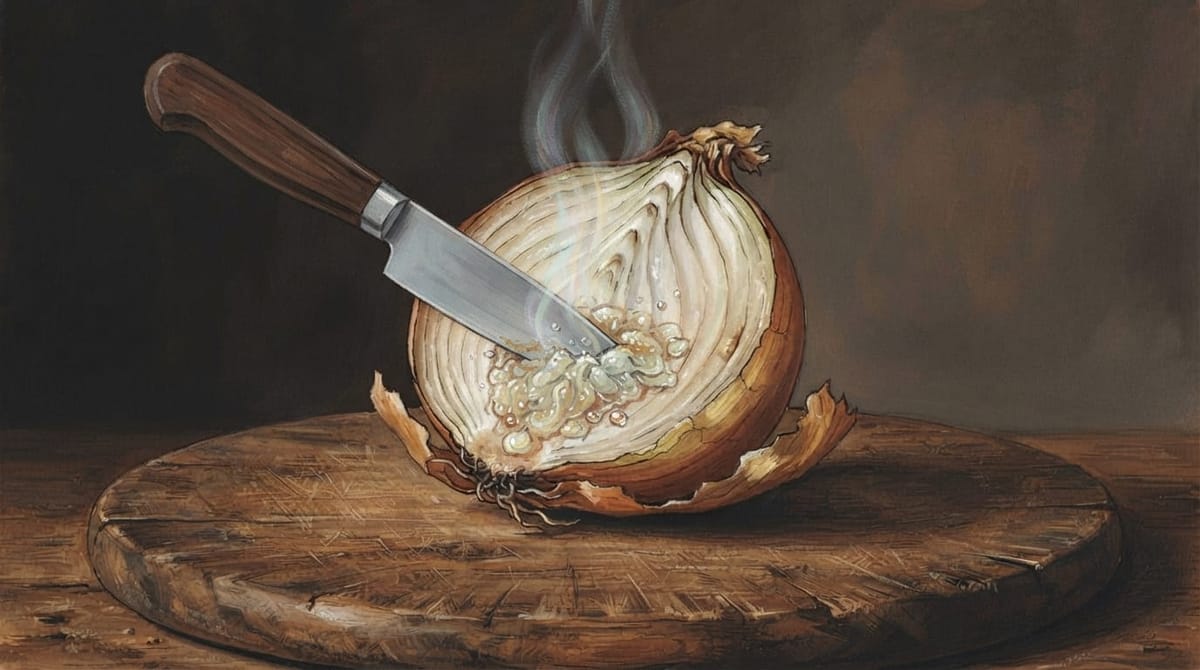
The knife breaks open cell after cell and their contents run together. The enzymes meet the sulfur-rich amino acids and turn them into unstable sulfenic acids, which rearrange into a small molecule with a long name: syn-propanethial-S-oxide. It is volatile, meaning it turns to vapour easily, so it lifts off the cut surface and floats up towards your face.
For years that last step was thought to happen by itself. In 2002 researchers in Japan showed that the onion has an enzyme whose job it is, and named it lachrymatory-factor synthase (lachrymatory means tear-making). They suggested that turning this one enzyme down could give an onion that keeps its flavour and spares the cook.
Read the source: Encyclopaedia Britannica: Why do onions make you cry? · Imai and others, Nature (2002): An onion enzyme that makes the eyes water
Why the eye answers with tears
When the vapour reaches the surface of your eye it causes a burning sensation. Your brain answers at once by setting off tears, to rinse the irritant away before it can do damage. The crying is a reflex that protects the eye. It has nothing to do with feeling sad.
Read the source: Encyclopaedia Britannica: Why do onions make you cry?
What actually helps
A sharp knife and a slow cut. In 2025 engineers at Cornell University filmed onions being cut at high speed. A blade first presses on the tough skin of an onion layer, pressure builds in the softer flesh beneath, and when the skin gives way a spray of fine droplets shoots out, some at up to 40 metres a second. The bluntest blades they tested threw out up to forty times as many droplets as the sharpest, and fast cuts about four times as many as slow ones. The fastest droplets, the authors note, are the ones most likely to reach the cook’s eyes.
Chilling the onion is the usual advice, because cold slows the enzymes, and sweet onions hold less sulfur to begin with. But in the Cornell tests onions kept at 1 °C for 12 hours gave off a noticeably larger volume of spray, so the fridge may help less than people say. Lighting a match, chewing bread or breathing through your mouth do little, if anything.
Read the source: Wu and others, Cornell University (2025): Droplet outbursts from onion cutting · Encyclopaedia Britannica: Why do onions make you cry?
A question worth taking into the lesson
“If the gas is only made after the cut, where were its ingredients a second before?” is the question to bring. Ask Clevaa to draw one onion cell with the enzymes and the sulfur compounds apart, then the same cell after the blade.
Then explain it back: the cut breaks the cells, enzymes turn sulfur compounds into a gas, the gas stings the eye, and tears wash it out.
A few useful answers
Does a sharp knife really make a difference?
Yes. In a 2025 experiment at Cornell University, blunt blades sprayed up to forty times as many droplets from the onion as sharp ones, and fast cuts about four times as many as slow cuts.
Do all onions sting the same?
No. Sweet varieties contain less sulfur than others, so they are less likely to burn your eyes.
Could an onion be grown that does not make you cry?
In principle. The gas is made by one dedicated enzyme, and the scientists who found it in 2002 suggested that turning it down could give an onion that keeps its flavour.
TAKE THE NEXT QUESTION WITH YOU
Turn the explanation into a conversation.
Open this topic in Clevaa, choose a level, and ask the part you want to explore.
Hear it explained with pictures ↗You choose when to start. Session availability and usage limits may apply.
Keep exploring
 EVERYDAY SCIENCE · ANIMALS
Why do cats purr?
A purr is a low buzz made in a cat’s voice box, on the breath in and the breath out. Cats purr when content, but also at the vet or when hurt, and scientists are still working out exactly how the sound is made.
Explore EVERYDAY SCIENCE · MAGNETISM
Why do magnets stick to the fridge?
A fridge door is not a magnet, but its steel is full of tiny magnetic regions. A magnet turns them to face it, the door becomes a magnet too, and the two attract. Why aluminium and some stainless steels will not hold one.
Explore LEARNING YOU CAN LOOK ATSee the idea you are trying to understand.
See ideas take shape with Clevaa, a visual AI tutor. Learn through spoken explanations, illustrations and diagrams, then ask about the part you want to understand.
Explore