
EVERYDAY SCIENCE · PLANTS
How does water get to the top of a tree?
A tree has no pump. Water is pulled up from the top: as it evaporates from the leaves, each molecule that leaves tugs on the one behind it, and because water molecules cling to one another the tug passes down an unbroken thread of water all the way to the roots. The Sun does the work.
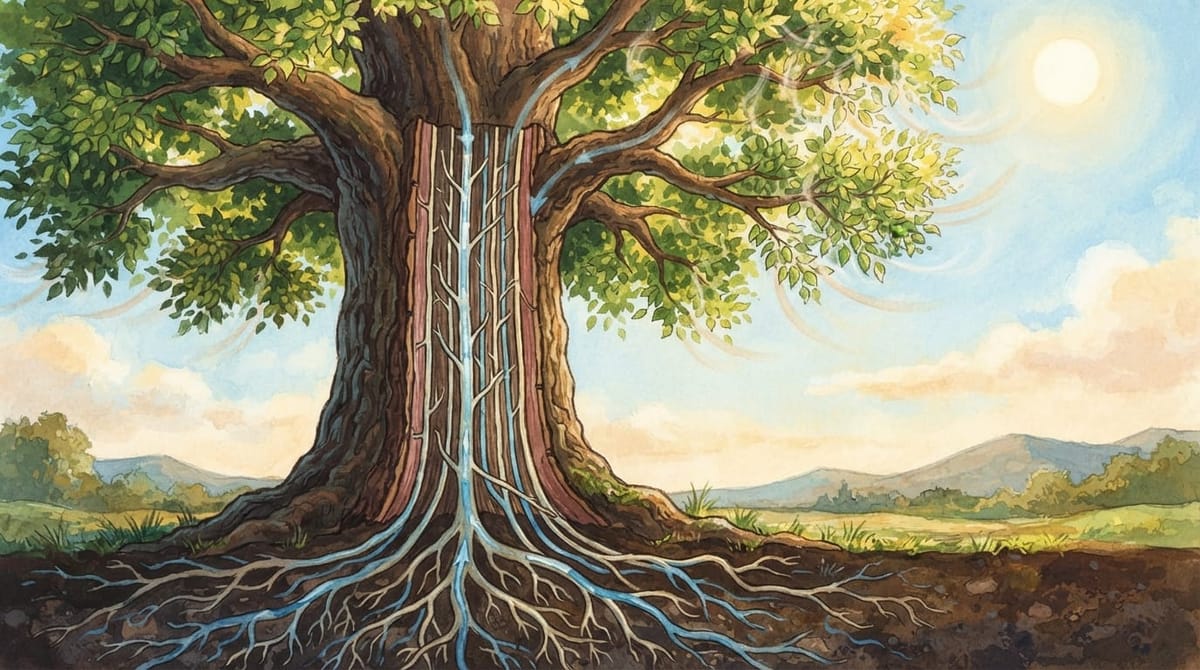
- Leaves lose water to the air
- Water clings to water
- The whole thread is pulled up
The puzzle of height
Sucking on a straw works because the air outside pushes the drink up. That push has a limit: the pressure of the atmosphere can hold up a column of water only about ten metres tall. Yet the tallest known tree, a redwood in California, stands 379 feet high, about 115 metres.
Roots do push a little. When the leaves are not losing water, pressure can build in the roots and squeeze droplets out at the edges of leaves, as on a lawn in the morning. But most of the water a plant moves is not pushed from below. And unlike an animal, a plant has no heart to drive it.
Read the source: Nature Education (Scitable): Water uptake and transport in vascular plants · U.S. National Park Service, Redwood: Frequently asked questions
From root to leaf
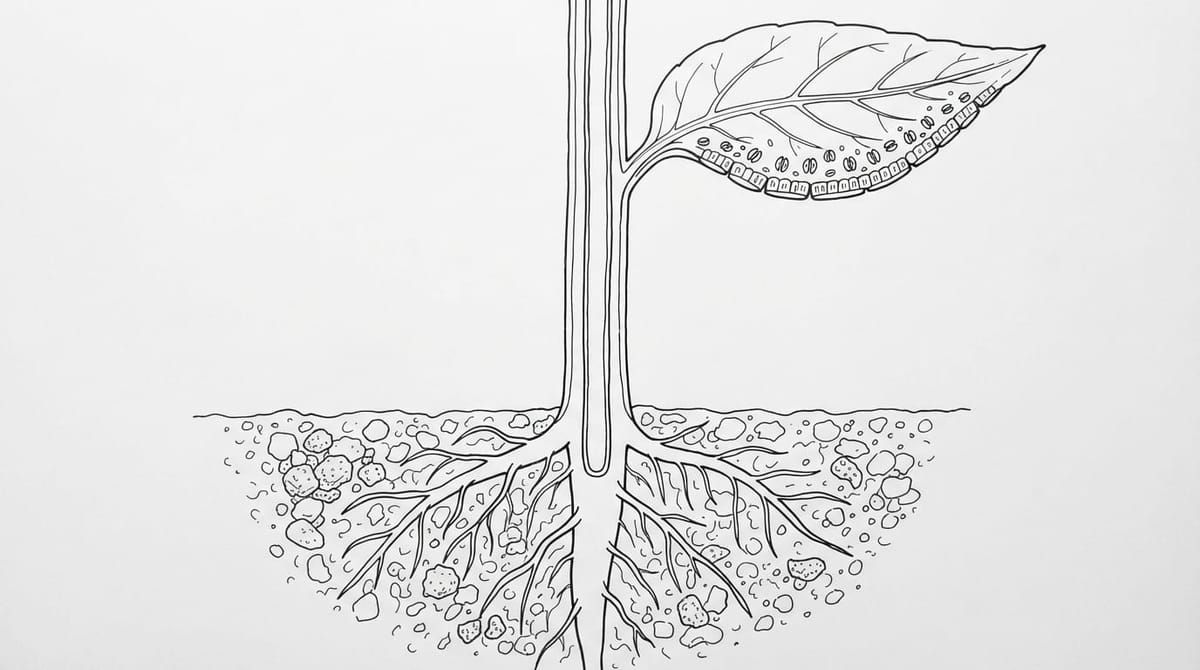
Water enters through the fine roots, whose root hairs give them a large surface in contact with the soil. It crosses to the middle of the root and enters the xylem, the plant’s water pipes. These begin as living cells, which die and empty themselves to leave hollow tubes. A vessel is about as wide as a human hair.
At the top the pipes end in the leaves, which are dotted with pores called stomata. The pores must open to let in the carbon dioxide a leaf needs to make sugar, and while they are open water escapes: about 400 molecules of water for every molecule of carbon dioxide taken in. A plant keeps less than 5% of the water it takes up. The rest passes straight through to the air.
Read the source: Nature Education (Scitable): Water uptake and transport in vascular plants
Water that holds on to water
Water is cohesive: its molecules stick to one another through hydrogen bonds. In a pipe as narrow as a xylem vessel, that lets a column of water behave less like something poured and more like a rope. Pull on the top and the pull travels all the way down.
The pull comes from the leaves. Water evaporates from the damp cell walls inside a leaf, driven by the Sun’s energy, and the surface of the water left behind draws more up to replace it. That force passes down the continuous columns to the roots, where it draws water in from the soil. Botanists call this the cohesion-tension mechanism, and Stephen Hales suggested it as early as 1727.
Read the source: Nature Education (Scitable): Water uptake and transport in vascular plants
A liquid under tension
Being pulled from above leaves the water in the pipes stretched, at a pressure below zero. That is why a tree is not held to ten metres: the atmosphere is not pushing the water up, the leaves are pulling it. The pipes are built for the strain. Rings in the walls of the vessels hold them open, much as the rings in a vacuum cleaner hose keep the hose from collapsing.
Height still has a price. The taller the tree, the harder the pull must be, and at some point the topmost leaves cannot get enough water to keep growing. A 2004 study of the tallest redwoods estimated a ceiling of about 122 to 130 metres for any tree.
Read the source: OpenStax Biology 2e: Transport of water and solutes in plants · Koch and others, Nature (2004): The limits to tree height
When the thread breaks
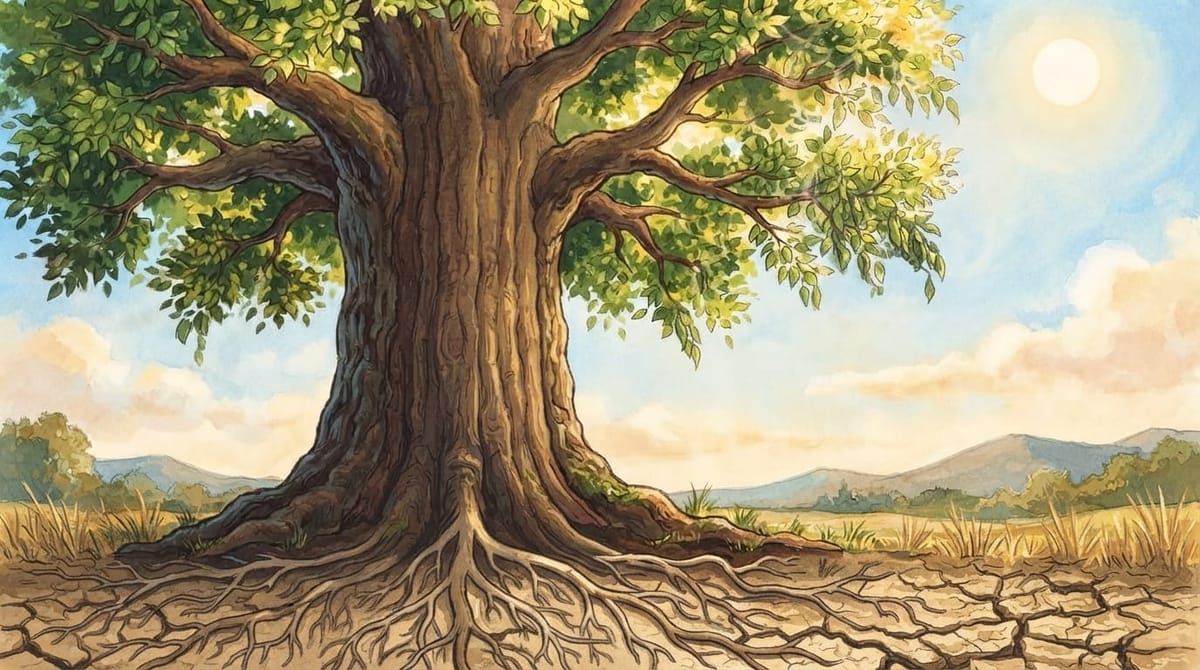
The rope can snap. If the pull becomes too great, as in a drought, an air bubble can form in a pipe and fill it. This is an embolism: the column in that pipe is broken and it stops carrying water. Freezing can do the same, because air comes out of solution as water turns to ice.
A plant can route water round a blocked pipe through small pits that link it to its neighbours, and it can grow new pipes to replace what is lost. It also closes its stomata in a drought to save water. When it still loses water faster than the roots supply it, the cells lose their firmness and the leaves wilt.
Read the source: Nature Education (Scitable): Water uptake and transport in vascular plants
A question worth taking into the lesson
“How can a liquid be pulled like a rope without breaking?” is the question to bring. Ask Clevaa to draw the water molecules in one narrow pipe, then ask what happens to the column above and below an air bubble.
Then explain it back: leaves lose water to the air, water molecules cling to one another, the pull passes down the thread to the roots, and a bubble breaks it.
A few useful answers
Do roots pump the water up?
Mostly no. Roots can build a little pressure when the leaves are not losing water, but most of the water is pulled from above by evaporation at the leaves.
Does the tree spend energy lifting water?
Not by pumping. The movement is passive: the Sun’s energy evaporates water from the leaves, and that drives the flow.
How much water does a tree use?
A great deal. Some large rainforest trees can use nearly 1,200 litres in a single day, and a plant keeps less than 5% of the water it takes up.
TAKE THE NEXT QUESTION WITH YOU
Turn the explanation into a conversation.
Open this topic in Clevaa, choose a level, and ask the part you want to explore.
Hear it explained with pictures ↗You choose when to start. Session availability and usage limits may apply.
Keep exploring
 EVERYDAY SCIENCE · WATER
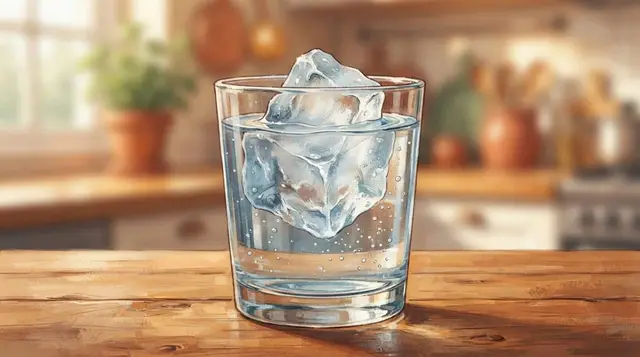
Why does ice float on water?
Water is one of very few substances whose solid is lighter than its liquid. Freezing locks the molecules into open six-sided rings, so ice takes about 9% more room. Why pipes burst and lakes freeze from the top.
Explore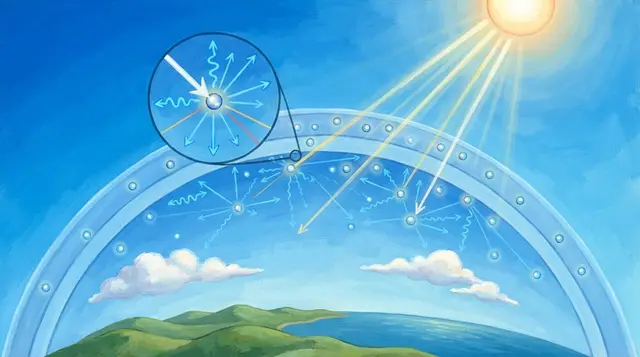 EVERYDAY SCIENCE · LIGHT
Why is the sky blue?
Air molecules scatter short blue wavelengths far more than red ones, so blue light reaches you from every part of the sky. Why sunsets are red, why clouds are white, and why the sky is not violet.
Explore A CONVERSATION WITH YOUR CURIOSITYAsk it the way you would ask a person.
Talk through a question with Clevaa, a voice AI tutor with visual explanations. Ask follow-ups, request a simpler example, or type whenever you prefer.
Explore