
EVERYDAY TECHNOLOGY · SHIPS
How does a submarine dive and come back up?
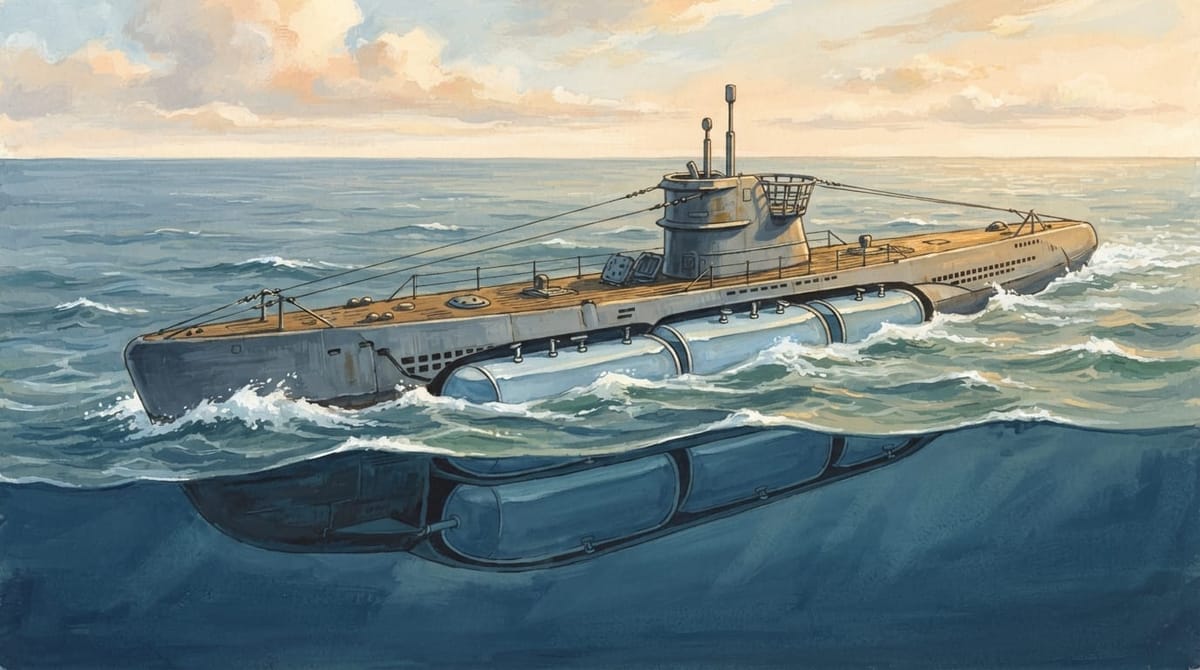
A submarine dives by letting seawater into its ballast tanks until it weighs more than the water it pushes aside, and comes back up by blowing that water out again with compressed air. Its hull stays the same size all the way down, so weight is the one thing the crew can change.
- Water pushes up on the hull
- Flooded tanks add weight
- Compressed air takes it away
Why a steel ship floats
Anything lowered into water pushes some water aside, and the water pushes back. Archimedes’ principle says how hard: the upward force equals the weight of the water displaced. If that push is greater than the object’s weight it floats, if less it sinks, and if the two are equal it stays where it is.
Steel is far denser than water, but a hull is mostly air. It pushes aside a great volume of water for its weight, so the push wins. A steel ship floats for the same reason a steel bowl does and a steel ball does not.
Read the source: OpenStax College Physics 2e: Archimedes’ principle
To sink, change the weight
A submarine’s hull is rigid, so the water it pushes aside hardly changes, and neither does the push. That leaves the weight. Every submarine carries main ballast tanks. On the surface they are empty of water, which lifts the deck and hatches clear of the waves. To dive, the crew opens vents at the top of the tanks and flood valves at the bottom. Air escapes upward, seawater pours in, and the boat becomes heavier than the water it displaces.
On some boats the flood openings simply stay open to the sea. The air trapped above keeps the water out, like an upturned glass pushed down into a basin, until the vents let that air go.
Read the source: Encyclopaedia Britannica: Naval architecture, ballast tanks · National Museum of the U.S. Navy: Dive! Dive! The history and technology of submarines (PDF)
Holding one depth
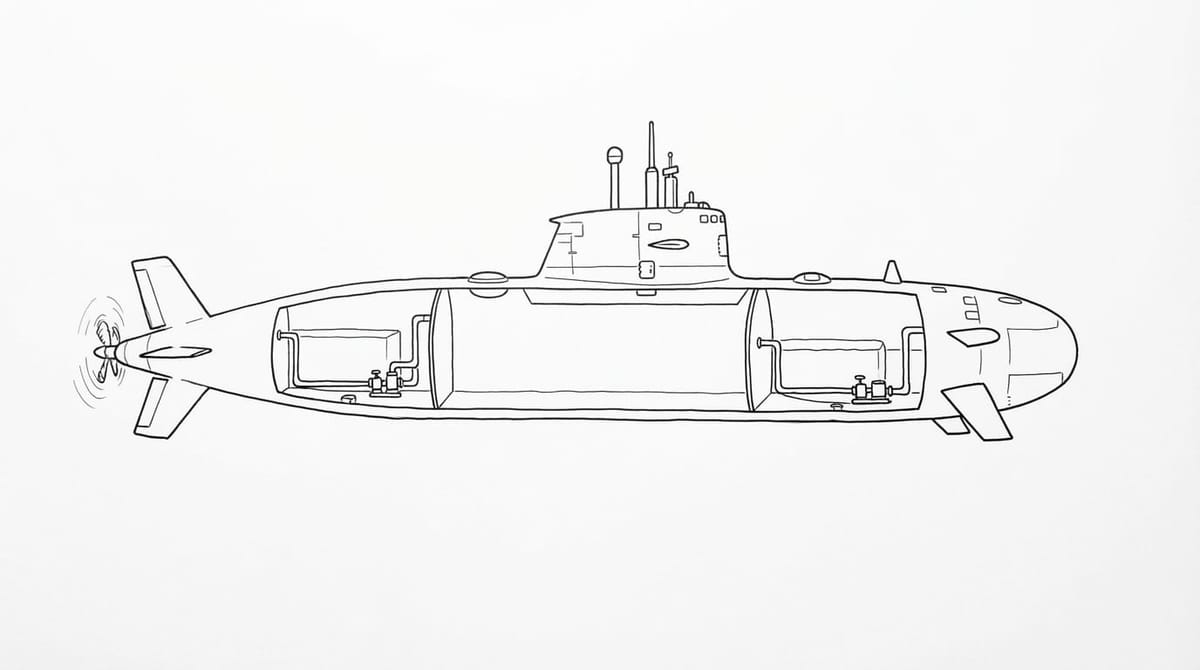
Sinking is the easy part. To stay at one depth the boat must weigh exactly as much as the water it displaces, which is called neutral buoyancy. A second set of smaller tanks does this fine work: water is taken in or pumped out a little at a time to keep the two in balance.
The balance keeps moving, because the sea is not the same everywhere. When a submarine passes from salt water into fresher, lighter water, the push on it drops and some water has to be pumped out. And once the boat is under way, diving planes, which work like the wings of an aeroplane, tilt it up or down.
Read the source: Encyclopaedia Britannica: Naval architecture, ballast tanks
Coming back up
To surface, the crew shuts the vents and lets compressed air, carried on board, into the ballast tanks. The air cannot get out at the top, so it drives the water out at the bottom. The boat is now lighter than the water it displaces, and the push carries it up.
The idea is older than steel hulls. A design of 1747 had goatskin bags attached to the hull, to be filled with water to go down and twisted empty to come up. USS Holland, which the U.S. Navy bought in 1900, used the then new technology of compressed air to empty its tanks, which ended pumping by hand.
Read the source: Encyclopaedia Britannica: Submarine · National Museum of the U.S. Navy: Dive! Dive! The history and technology of submarines (PDF)
A question worth taking into the lesson
“If the hull never changes size, what exactly changes between floating and sinking?” is the question to bring. Ask Clevaa to draw the tanks on the surface, flooding and being blown, then ask why a boat that is perfectly balanced in the open sea starts to sink at a river mouth.
Then explain it back: the water’s push depends on how much water the hull displaces, flooding the tanks adds weight, compressed air takes the weight away, and small tanks and planes hold the depth.
A few useful answers
Why does a steel ship float?
Because the hull encloses a lot of air and so pushes aside a large volume of water. The water pushes up with a force equal to the weight of the water displaced, and for a ship that is more than its own weight.
What is neutral buoyancy?
The state in which a submerged object weighs exactly as much as the water it displaces, so it neither rises nor sinks. Submarines reach it by taking in or pumping out small amounts of water.
What do the diving planes do?
They are small wings on the hull. When the boat is moving, tilting them steers it up or down, much as wings do for an aeroplane.
TAKE THE NEXT QUESTION WITH YOU
Turn the explanation into a conversation.
Open this topic in Clevaa, choose a level, and ask the part you want to explore.
Hear submarines explained with pictures ↗You choose when to start. Session availability and usage limits may apply.
Keep exploring
 EVERYDAY SCIENCE · WATER
Why does ice float on water?
Water is one of very few substances whose solid is lighter than its liquid. Freezing locks the molecules into open six-sided rings, so ice takes about 9% more room. Why pipes burst and lakes freeze from the top.
Explore EVERYDAY SCIENCE · OCEANS
Why is the sea salty?
Rain slowly breaks down rock on land and rivers carry the dissolved minerals to the sea. Water leaves the sea again by evaporating; the salt stays. Why rivers taste fresh, how salty the sea is, and what the seabed adds.
Explore LEARNING YOU CAN LOOK ATSee the idea you are trying to understand.
See ideas take shape with Clevaa, a visual AI tutor. Learn through spoken explanations, illustrations and diagrams, then ask about the part you want to understand.
Explore